

How Do You Pull Off Minimalist Decor in a Small Rental?
Editorial TeamLast Updated: October 27, 2026
Quick Summary
Minimalist decor works in a small rental by fixing two things first: a palette of two neutrals plus one supporting tone, and clean, simple shapes. Then free floor space with wall-mounted shelves, under-bed storage, mirrors, and reversible, damage-free hanging methods.
- Choose a light base, a mid neutral, and one supporting tone such as sage or soft clay.
- Mount shelves above eye level and pick a low-profile sofa to keep the floor open.
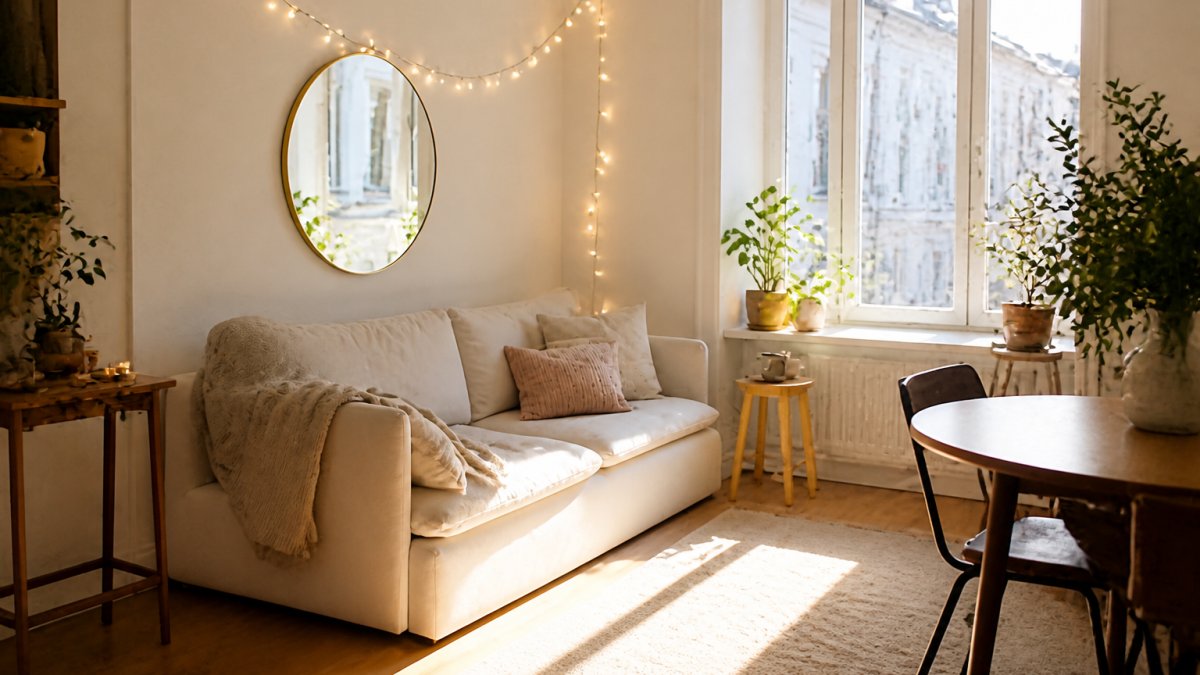
- Hang a mirror opposite a window at eye level to double daylight and widen narrow rooms.
- Test one adhesive strip in a corner for 24 hours before hanging anything heavier than a frame.
- Leave at least 30 inches for main walking paths and 18 inches between furniture pieces.
Table of Contents
- Start With a Clean Palette and Clean Lines
- Small Apartment Decorating Ideas That Buy You Floor Space
- Renter-Friendly Decor Ideas You Can Undo in an Afternoon
- Small Space Storage Ideas That Keep Surfaces Clear
- Multifunctional Furniture for Small Apartments: What to Measure First
- Budget Tiers: What Minimalist Decor Actually Costs
- Build Your First Minimalist Room With Practical Home Essentials
- Frequently Asked Questions
Start With a Clean Palette and Clean Lines
Minimalist decor works in a rental because it asks less of a room, not more. Before you buy a single shelf, fix the palette and the lines. Get those two right and the space reads calm even with beige landlord walls.
Clean lines mean simple shapes: a rectangular table, a low sofa, straight-edged shelves. Skip anything with heavy carving or busy patterns. The eye needs fewer things to land on.
Pick Two Neutrals and One Supporting Tone
Two neutrals plus one supporting tone is the fastest way to a calm space. Choose a light base like white or warm gray, a mid neutral like oatmeal or taupe, and one supporting tone, such as sage or soft clay. Then keep every textile, frame, and vessel inside that trio.
This is the rule that keeps a minimalist decor scheme from drifting. When you see something you love in a fourth color, walk away. Supporting neutrals do the quiet work; the accent tone does the talking.
Small Apartment Decorating Ideas That Buy You Floor Space
Small apartment decorating ideas should give floor back, not take it. The trick is to move visual weight upward and inward: shelves on walls, storage inside furniture, and fewer freestanding pieces.
- Mount shelves above eye level so the floor stays open
- Choose a low-profile sofa so the wall behind it reads taller
- Swap a coffee table for a slim tray on a stool
Use Mirrors and Light to Make Rooms Feel Larger
A mirror placed opposite a window doubles the daylight and makes a narrow room feel wider. Hang it at eye level, not near the ceiling. Then add two or three small light sources instead of one overhead bulb.
Renter-Friendly Decor Ideas You Can Undo in an Afternoon
Renter-friendly decor ideas share one trait: they leave no holes and no residue. But the difference between a deposit-safe install and a costly repair comes down to matching the method to the wall and testing before you commit. Here is a practical, lease-safe playbook for reversible decorating that you can undo in an afternoon.
Damage-Free Hanging: Match the Hardware to the Wall
Adhesive strips are the default, but they are not universal. Most practitioners find that command strips hold best on smooth, painted drywall that has cured for at least 30 days. On textured walls, fresh paint, or wallpaper, adhesive failure is common. Test one strip in a corner for 24 hours with a light load before hanging anything heavier than a frame.
- Frames and light art: use two interlocking adhesive strips per pound of weight, placed on the back of the frame rather than the wall. For a 5-pound frame, use two pairs of strips rated for 3 pounds each.
- Mirrors and heavier pieces: leaning is safer than hanging. A floor mirror against the wall needs no hardware and comes down in seconds.
- Curtains: tension rods work in window frames with a consistent width and no obstructions. Measure the inside width at the top, middle, and bottom, older rental windows are rarely square, and a rod that fits the top may slip at the bottom.
Reversible Finishes That Skip the Landlord Conversation
Temporary wallpaper and peel-and-stick tiles are popular, but they are not all equal. Most practitioners recommend testing a small square in an inconspicuous spot for a week before committing to a full wall. Look for products labeled removable or repositionable, and avoid applying them over freshly painted walls (wait 30 days) or in bathrooms with high humidity, where adhesive can soften and mold.
- Peel-and-stick wallpaper: best on smooth, primed drywall. Avoid on brick, concrete, or walls with peeling paint.
- Removable backsplash tiles: work on smooth, clean surfaces. Clean the wall with a degreaser first; kitchen grease is the most common cause of failure.
- Temporary floor decals: not recommended for rentals with original hardwood or tile, as residue can stain grout or finish.
Move-Out Restoration: The 30-Minute Checklist
When your lease ends, restoration is about speed and order. Work top to bottom and remove adhesive while the room is warm, adhesive releases more cleanly at room temperature than in a cold apartment.
- Remove all adhesive strips and hooks using the stretch method.
- Wipe residue with a cloth dampened with rubbing alcohol; test on a hidden spot first.
- Remove tension rods and peel-and-stick items slowly, starting at a corner.
- Patch any accidental holes with lightweight spackle and a putty knife; sand smooth and touch up with matching paint if you have it.
- Photograph each wall before you leave, this is your proof if a deposit dispute arises.
Small Space Storage Ideas That Keep Surfaces Clear
Small space storage ideas work best when every item has a home below eye level or above it, never on the counter.
Start with vertical space. Floating shelves above a desk or sofa hold books and a plant without eating floor.
A black scalloped tray can provide one defined spot for small items on a coffee table. Our scallop small tray in black is $65.50.
Multifunctional Furniture for Small Apartments: What to Measure First
Multifunctional furniture for small apartments only pays off if it fits, so measure before you buy. Three numbers decide it: the wall length you can dedicate, the clearance you need to open or convert the piece, and the doorway width for delivery. But the fourth number, circulation clearance, is the one most renters skip, and it is the one that determines whether a room feels cramped or calm.
The Four Measurements That Matter
- Wall length: measure the longest uninterrupted wall in the room. Subtract 12 inches on each side if you want the piece to breathe; a sofa that spans wall to wall makes a small room feel smaller.
- Conversion clearance: for a sofa bed, measure the depth of the bed when fully extended (typically 70-80 inches for a full-size sleeper) plus 12 inches of walking space. For a wall bed, measure the ceiling height and the floor space in front of the wall, most need at least 30 inches of clearance to fold down.
- Doorway width: measure the narrowest door the piece must pass through, including the diagonal of the stairwell if you live above the first floor. A piece that fits the room but not the hall is a return waiting to happen.
- Circulation clearance: leave at least 30 inches for main walking paths and 18 inches between furniture pieces. In a studio, that often means one clear path from door to window and a second from bed to bathroom.
Room-by-Room Layouts for Genuinely Small Floor Plans
Studio (under 400 sq ft): zone with furniture, not walls.
Narrow living room (under 12 ft wide): place the sofa against the long wall and use a slim console behind it if you need storage.
Compact bedroom (under 120 sq ft): a bed placed in a corner frees one full wall for a dresser and a small desk.
Small kitchen (under 80 sq ft): a rolling island or a slim cart (24-30 inches wide) adds prep space and moves out of the way when not in use.
Multifunctional Pieces: The Trade-Offs
A storage ottoman that doubles as a coffee table is the low-risk pick: it is lightweight, inexpensive, and easy to move.
A drop-leaf table is a middle ground for dining: it seats two when open and folds to the width of a console when closed. Measure the open and closed depths, most drop-leaf tables are 30-36 inches deep when open and 9-12 inches when closed.
Budget Tiers: What Minimalist Decor Actually Costs
Minimalist decor costs less than most renters expect, because the look depends on restraint, not price. Here is how we would split a first-room budget:
| Tier | What you buy | Approx. spend |
|---|---|---|
| Starter | Tray, string lights, one plant | Under $100 |
| Mid | Sheets, two shelves, mirror | $100-$250 |
| Room refresh | Sideboard or large storage piece | $250+ |
Our indoor and outdoor decorative string lights start at $10.00, and the Tache Microfiber Cloud White Bed Sheet Set starts at $19.40. A white base like that lets you change the look of a room without buying new sheets. For more budget-friendly aesthetic room decor ideas for students, including DIY tips and lighting solutions, see our companion guide.
Build Your First Minimalist Room With Practical Home Essentials
Build the room in one order: palette, then storage, then light, then the one object you actually love. That sequence keeps you from buying decor that fights the space.
- Palette first: two neutrals and one supporting tone
- Storage second: shelves and under-bed space before surface decor
- Light third: two or three small sources, not one overhead
For the last step, consider our small shell platter in white swirl or the black wood sideboard with a sliding glass door.
Frequently Asked Questions
What are some minimalist ideas for a small apartment?
Start with fewer, larger pieces instead of many small ones. Choose a two-neutral palette, keep tabletops clear except for one deliberate object like a tray, and put storage on the walls with floating shelves. Add one houseplant and one mirror for life and light. The goal is not an empty room but a calm space where each item has a purpose and a place to live.
What is the 3-5-7 rule in decorating?
The 3-5-7 rule is a styling guideline for grouping accessories in odd numbers, usually three, five, or seven items, at varied heights. It works well with minimalist decor because it caps how much you display. A tray with three objects or a shelf with five books and one bowl reads intentional rather than cluttered. Treat it as a starting point, not a strict law.
How can I decorate a rental apartment without making permanent changes?
Use removable adhesive hooks for wall art, tension rods for curtains, and freestanding furniture for storage. Floor-to-ceiling curtains hung on a tension rod hide rental blinds and add height without drilling. Swap cabinet hardware back before move-out. Keep every receipt and store original parts in one labeled box so the unit returns to its original condition.
What furniture works best in a small rental apartment?
Measure your room and doorways before choosing furniture.
How do you make a small apartment feel bigger with minimalist decor?
Keep the floor visible, hang curtains high and wide, and place a mirror opposite a window to bounce natural light. Choose light colors on walls and large furniture, and limit wall art to one or two simple pieces per room. Fewer objects mean less visual noise, which reads as more space even when the square footage has not changed.
The hardest part of minimalist decor is not the buying. It is stopping at enough. If your surfaces are clear, your palette is tight, and your storage is doing its job, you are done.
PracticalHomeEssentials.com can help you finish the room with a curated selection, home delivery, and free shipping available. Browse bedding, decor, and storage, choose your options, and build a space that moves with you to the next lease.
