

How to Furnish a Home Office Cheaply (2026 Guide)
Table of Contents
- What You'll Need Before You Start
- Best Budget Home Office Furniture: What to Prioritize
- DIY Home Office Desk Ideas That Cost Almost Nothing
- How to Furnish a Home Office Cheaply Using Vertical Storage
- Small Home Office Organization Tips That Keep Clutter Out
- Lighting, Ambiance, and Video Call Background Aesthetics
- Tech-Specific Budget Setups for Remote Workers
- How to Furnish a Home Office Cheaply: Common Mistakes to Avoid
Last Updated: August 19, 2026
Setting up a productive workspace without draining your bank account is entirely achievable. This guide covers how to furnish a home office cheaply, from what to prioritize on day one to the mistakes that quietly waste your budget.
What You'll Need Before You Start
Before spending a single dollar, take stock of what you already have. A home office cheaply assembled from existing household items will always beat one built from scratch on a tight budget.
Start with a floor plan sketch and measure your available space in inches. Know your wall dimensions before you buy anything, because purchasing furniture that doesn't fit and can't be returned easily is the biggest budget mistake.
Here's a quick pre-shopping checklist:
- Measure the room (length, width, ceiling height)
- Identify natural light sources and outlet locations
- List furniture you already own that could be repurposed
- Set a firm total budget before browsing anything
- Decide whether the setup needs to double as a guest room or shared space
Even in a studio apartment, a dedicated corner signals to your brain that work happens here. That psychological boundary matters more than any piece of furniture.
Best Budget Home Office Furniture: What to Prioritize
The biggest mistake when furnishing a home office cheaply is spending evenly across everything. Spend most of your budget where your body makes contact: the chair, then the desk surface. Everything else can be sourced secondhand, built from scratch, or substituted with household items.
| Item | Priority | Budget Strategy |
|---|---|---|
| Chair | Highest | Buy secondhand or refurbished; don't skip |
| Desk surface | High | DIY or repurpose existing furniture |
| Lighting | Medium | Thrift stores, clip-on options |
| Storage/shelving | Medium | Floating shelves, pegboards, DIY |
| Monitor stand | Low | Stack books, use a box initially |
| Decor | Lowest | Add last with what's left |
Ergonomic Trade-Offs You Should Know Before You Buy
The real trade-off isn't comfort versus cost, it's short-term savings versus long-term health costs. According to the Occupational Safety and Health Administration's ergonomics guidelines, prolonged poor posture contributes to musculoskeletal disorders among the most common workplace injuries.
A chair without lumbar support will feel fine for two weeks. By month two, many people develop lower back pain that disrupts sleep and productivity far more than any budget decision.
Practical guidance for budget ergonomics:
- A chair with adjustable seat height is non-negotiable. Fixed-height chairs cause knee and hip strain.
- Desk height should allow your elbows to rest at roughly 90 degrees when typing.
- If you can only afford a basic chair, a rolled towel placed at the lumbar curve adds meaningful support at zero cost.
- Monitor height matters: the top of your screen should sit at or just below eye level.
Second-Hand Sourcing Strategies That Actually Work
Office liquidation sales are the best-kept secret in budget home office setup. When companies downsize or close offices, they sell high-quality ergonomic chairs and standing desks for a fraction of retail. Search for "office liquidation" plus your city on any classifieds platform.
Other reliable channels:
- Facebook Marketplace and local buy-nothing groups: Set alerts for specific items rather than browsing.
- University surplus sales: Colleges sell office furniture seasonally, often including adjustable chairs in good condition.
- Estate sales: Frequently overlooked for office furniture.
- Corporate moving sales: Companies relocating often sell furniture rather than transport it.
Condition matters more than brand. A well-maintained generic chair beats a neglected name-brand one. Check adjustment mechanisms in person before buying.
DIY Home Office Desk Ideas That Cost Almost Nothing
A solid desk doesn't require a furniture store. The most reliable DIY home office desk ideas use surfaces you can find for under twenty dollars combined with supports you already have or can source free.
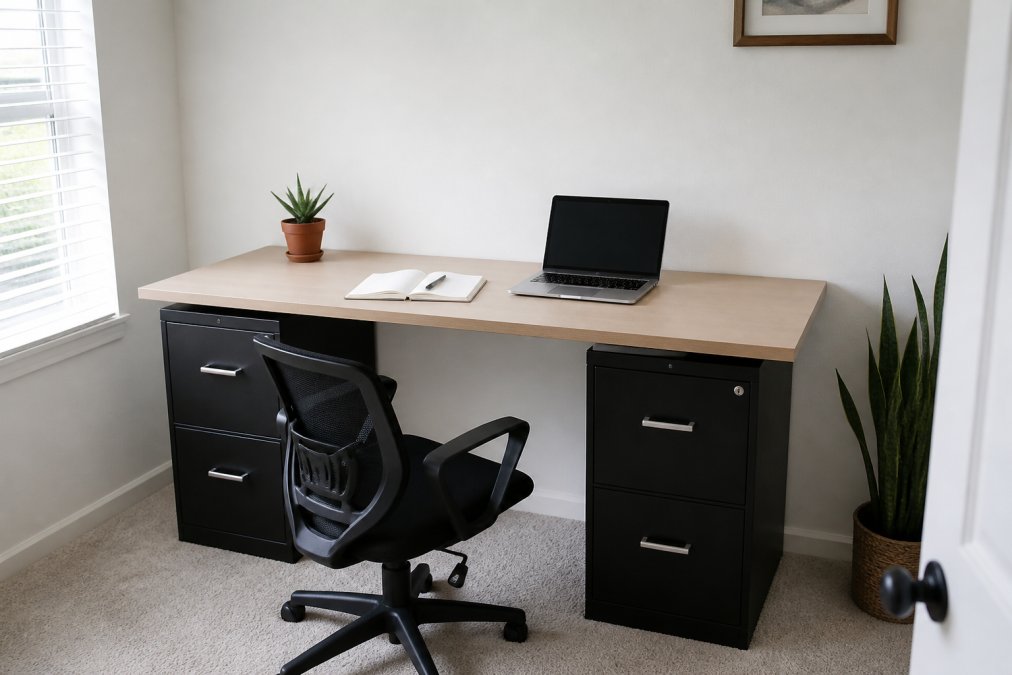
The classic approach: a hollow-core door blank from a hardware store laid across two filing cabinets. You get a wide, stable surface at a fraction of desk prices. File cabinets double as storage.
Other DIY desk options that work:
- Floating wall desk: Mount a solid shelf bracket to the wall and top it with plywood or a butcher block offcut.
- Repurposed dining table: A small two-person dining table works perfectly as a home office desk.
- IKEA-style hack: A basic tabletop paired with adjustable legs creates a custom-height desk.
- Repurposed kitchen island cart: Mobile, has storage underneath, and can be moved when you need the space back.
How to Furnish a Home Office Cheaply Using Vertical Storage
Floor space is the most expensive real estate in a small home office. Vertical storage is the single biggest space-saving move available to budget home office setups.
Floating Shelves and Pegboards
Floating shelves are the most cost-effective storage solution. A set of three staggered shelves above your desk can hold books, a printer, storage boxes, and decor items, clearing your desk surface entirely.
Installation requires only a stud finder, a level, and basic wall anchors. According to the American Institute of Architects' residential design guidelines, proper wall anchoring for shelves rated at 20-30 pounds per shelf requires hitting at least one stud or using toggle bolts rated for drywall loads.
Pegboards deserve more credit. A 2-foot by 4-foot pegboard mounted above or beside your desk creates a fully customizable organization system. Hooks, small shelves, bins, and cable organizers all attach without tools. Monochromatic pegboard setups look intentional and polished.
Small-Space Acoustics on a Shoestring Budget
Acoustics matter enormously for remote workers. Hard surfaces, bare floors, and bare walls create echo and reverb that microphones amplify.
The fix costs almost nothing:
- Bookshelves filled with books are the most effective acoustic treatment most people already own.
- A rug under the desk area reduces floor reflections noticeably.
- Curtains or drapes on windows absorb sound and improve video call lighting simultaneously.
- A fabric-covered bulletin board mounted behind your monitor doubles as acoustic treatment and organization.
If your voice sounds hollow on calls, people will assume your setup is unprofessional regardless of camera or lighting quality.
Small Home Office Organization Tips That Keep Clutter Out
Clutter is the enemy of focus. The most effective small home office organization tips share one principle: everything needs a designated place before it enters the workspace.
Start with a declutter pass. Pull everything off your current desk surface and only return items you use daily. Weekly-use items go in a drawer or nearby shelf.
Practical organization systems that work in small spaces:
- Inbox/outbox trays stacked vertically take up half the footprint of side-by-side versions
- Labeled bins on floating shelves make it easy to put things away
- A single drawer organizer for desk supplies eliminates the junk drawer problem
- A weekly reset habit, five minutes every Friday, prevents accumulation
Cable Management Without Buying Expensive Accessories
Effective cable management on a shoestring budget:
- Binder clips on desk edges: Thread cables through the metal loops.
- Velcro cable ties: A pack costs a few dollars and handles most cable bundling needs.
- Command strips and cable clips: Adhere clips to the underside of your desk to route cables out of sight.
- A cardboard box or small basket under the desk hides a power strip and excess cable length.
The goal is getting cables off the floor and off the desk surface.
Lighting, Ambiance, and Video Call Background Aesthetics
Lighting is where budget home offices most often look cheap, and it's entirely avoidable.
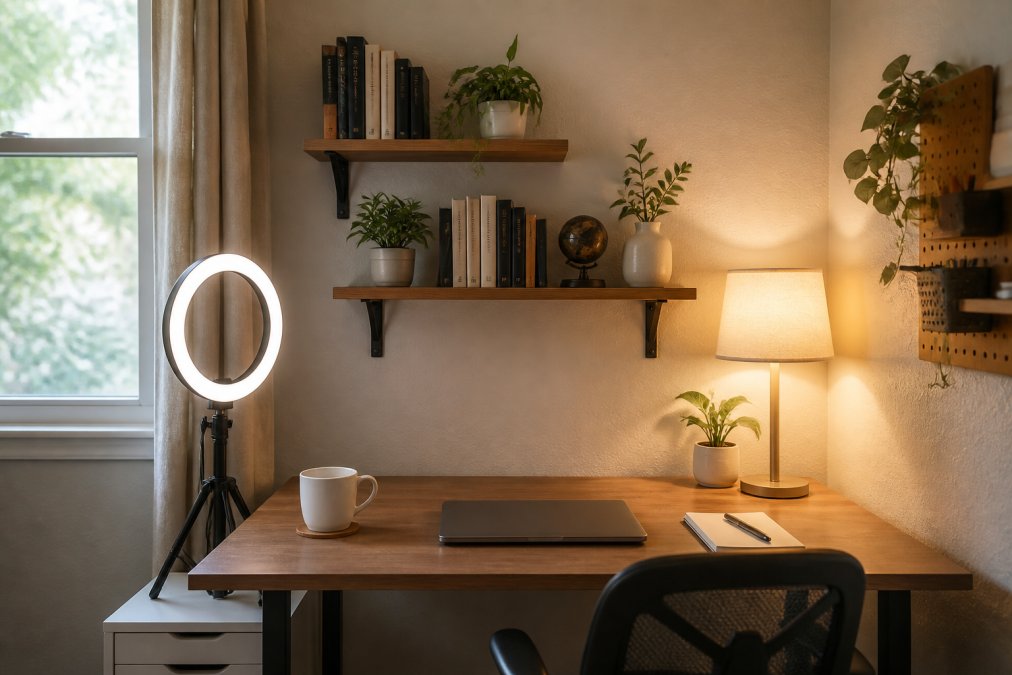
Task lighting is the priority. Your primary light source should illuminate your work surface without creating screen glare. A simple adjustable desk lamp positioned to your non-dominant side handles this effectively.
For video calls, the background aesthetic matters. A well-lit, tidy background with a few intentional elements signals competence and professionalism.
Budget video call background setup:
- Position your desk so a wall is behind you, not a window
- Add one or two small plants on a shelf behind you
- A ring light or clip-on LED panel positioned in front of you at eye level creates even, flattering light
- Ambient lighting from a small lamp behind your monitor reduces eye strain
The minimalist approach works best. A monochromatic wall with one or two intentional items looks more professional than a heavily decorated space.
Tech-Specific Budget Setups for Remote Workers
The furniture and organization side is only half the equation. According to the Bureau of Labor Statistics' American Time Use Survey, remote workers spend significant time on video calls and collaborative digital tasks. Your tech setup directly affects your productivity and professional image every day.
Budget tech priorities for a home office:
- A wired internet connection is worth the cable run if you're doing frequent video calls.
- A USB hub eliminates the frustration of limited laptop ports.
- An external keyboard and mouse let you position your laptop screen at eye level without sacrificing usability.
- A basic webcam is a meaningful upgrade from a built-in laptop camera.
The one tech item worth spending more on: your internet connection. A faster, more reliable plan eliminates productivity losses from dropped calls and buffering.
How to Furnish a Home Office Cheaply: Common Mistakes to Avoid
Buying everything at once. The urge to set up a complete office in a weekend leads to impulse purchases. Buy your chair and desk first. Use the space for two weeks, then identify what's actually missing.
Prioritizing aesthetics over function. A beautiful desk that's the wrong height or a stylish chair that offers no lumbar support are budget mistakes that fail in daily use.
Ignoring the floor plan. Furniture that doesn't fit the space is the most expensive mistake. Measure twice, buy once.
Skipping the lighting assessment. Morning light, afternoon light, and artificial light all behave differently. Spend a full workday in the space before deciding what lighting you need.
Over-investing in decor before function is solved. A workspace that functions well but looks plain is far more productive than a photogenic one that's uncomfortable.
As noted in Harvard Business Review's research on workspace design and productivity, the physical environment of a workspace has measurable effects on cognitive performance and sustained focus. Getting the fundamentals right, ergonomics, lighting, organization, matters more than surface aesthetics.
The goal of furnishing a home office cheaply is to spend correctly: prioritizing what affects your health and productivity, sourcing everything else economically, and building a space that genuinely supports the work you do every day.
Frequently Asked Questions
How can I set up a home office with no money?
Start by repurposing what you already own. A sturdy dining chair, a cleared kitchen table, or a bookshelf pulled from another room can form the foundation of a functional workspace. Declutter a dedicated corner, use a power strip you already have for cable management, and position your setup near a window for free natural light. The goal is to define the workspace first; you can add pieces gradually as your budget allows.
What are the essential items for a budget-friendly home office?
The non-negotiables are a flat work surface at the right height, a chair that supports your lower back, adequate task lighting, and some form of storage to keep clutter off your desk. Everything else, including monitor arms, decorative shelves, and cable organizers, improves comfort and aesthetics but is optional. Furnishing a home office cheaply means spending on these four essentials first and sourcing the rest second-hand or DIY.
How do I make a small home office look professional on a budget?
A monochromatic or two-tone color scheme makes any space look intentional without costing much. Keep surfaces clear, use vertical storage like floating shelves to move clutter off the floor, and pay attention to your video conferencing background: a tidy bookshelf or a simple framed print reads as polished on camera. Good task lighting eliminates shadows and makes a noticeable difference in how professional you appear during video calls.
What are some DIY ideas for home office desks and shelving?
A hollow-core door blank laid across two two-drawer filing cabinets gives you a wide, stable desk surface for well under $100 total when sourced second-hand. For shelving, standard pine boards from a hardware store cut to length and mounted with basic brackets cost a fraction of retail floating shelves. A pegboard panel screwed to the wall above your desk handles tools, headphones, and small organizers, keeping your desktop clear without buying a single storage unit.
Remote workers and first-time home office builders consistently underestimate how much the right essentials matter for daily productivity. PracticalHomeEssentials.com offers a curated selection of home office and organization products designed to make this process straightforward, with free shipping available and a wide product selection that covers everything from storage solutions to desk accessories. Choose options that work for your space, your budget, and the way you actually work.
This article was written using GrandRanker