

How to Choose Lighting for Small Living Rooms
Editorial TeamTable of Contents
- Start With a Small Living Room Lighting Plan
- Small Living Room Lighting Ideas That Save Space
- Layered Lighting for Living Rooms: Ambient, Task, and Accent
- Living Room Lighting Without Overhead Lights
- Best Light Bulbs for Living Rooms: Lumens, Kelvin, and Dimmers
- Fix Glare, Shadows, and Screen Reflections
- Rental-Friendly and No-Wiring Lighting Solutions
- Frequently Asked Questions
Last Updated: October 19, 2026
Start With a Small Living Room Lighting Plan
Most people buy a lamp, plug it in, and hope the room feels better. That is backwards.
A living room needs roughly 10 to 20 lumens per square foot. Multiply length by width for square footage, then multiply by your lumens target.
We suggest splitting that total across three sources so no single bulb does all the work.
Measure Your Room and Set a Lumens Target
Grab a tape measure and note length, width, ceiling height, outlet locations, and where the sofa, TV, and walkways land.
Then set your target using this quick reference:
| Room Size | Square Feet | General Lighting Target | Reading Corner Boost |
|---|---|---|---|
| 8 x 10 ft | 80 | 800-1,600 lumens | Add 450-800 lumens |
| 10 x 12 ft | 120 | 1,200-2,400 lumens | Add 450-800 lumens |
| 12 x 14 ft | 168 | 1,700-3,400 lumens | Add 450-800 lumens |
| 12 x 18 ft | 216 | 2,200-4,300 lumens | Add 450-800 lumens |
Treat the low end as cozy and the high end as bright and task-friendly. Small rooms rarely need the top of the range.
Small Living Room Lighting Ideas That Save Space
Space-saving lighting moves light off the floor and onto walls, ceilings, and slim footprints, freeing square footage while spreading light evenly. What most guides skip is the layout step, where each fixture actually goes. Here are three layouts you can copy.
Layout A: Sofa Against the Long Wall, TV Opposite
This is the most common small living room shape, and where glare goes wrong most often.
- Two corners behind the sofa: one slim floor lamp in each corner, or one floor lamp plus one plug-in sconce. Aim the shades up or toward the wall so light washes the room instead of hitting the TV screen.
- Beside the sofa: a narrow table lamp on an end table, sized so the shade bottom sits at about seated eye level (roughly 36 to 42 inches from the floor).
- Opposite the sofa, near the TV: keep this zone dim. A small accent lamp on a console or shelf, not a bright task light, so the screen stays the brightest thing in your line of sight.
Layout B: Sofa Floating in the Middle of the Room
A floating sofa splits the room into a seating zone and a walkway; lighting should reinforce that split.
- Behind the sofa: a console table with a pair of matching table lamps gives you light at seated height and defines the back of the seating area without a wall.
- Over the seating zone: an arc lamp or a floor lamp with a reading arm reaches over the sofa so you do not need ceiling wiring.
- Walkway side: keep it clear. No floor lamps in the path between the door and the seating area; use a wall sconce or a shelf lamp instead.
Layout C: Narrow Room With One Window
In a long, narrow room, light the short walls to make the room feel wider.
- Short wall opposite the window: a floor lamp or a pair of sconces washes that wall and visually pushes it back.
- Along the long walls: use slim table lamps on narrow consoles rather than floor lamps, which eat the little width you have.
- Near the window: a low accent source (string lights or a small shelf lamp) balances the daylight without competing with it.
Fixture Trade-Offs in a Small Room
| Fixture | Floor Space Used | Best For | Watch Out For |
|---|---|---|---|
| Slim floor lamp | About 1 square foot | Corners, reading beside the sofa | Shade height vs. seated eye level |
| Arc lamp | Base only, light overhead | Floating sofas, low ceilings | Needs a weighted base; can tip |
| Table lamp | None (uses tabletop) | End tables, consoles | Takes up table surface you may need |
| Plug-in sconce | None | Blank walls, rentals | Cord routing to an outlet |
| String lights | None | Accent, corners, shelves | Can look cluttered if overdone |
Count how much floor you can spare, in a compact room, usually two corners and one side table. Build around those spots and match the layout to your room shape before buying anything.
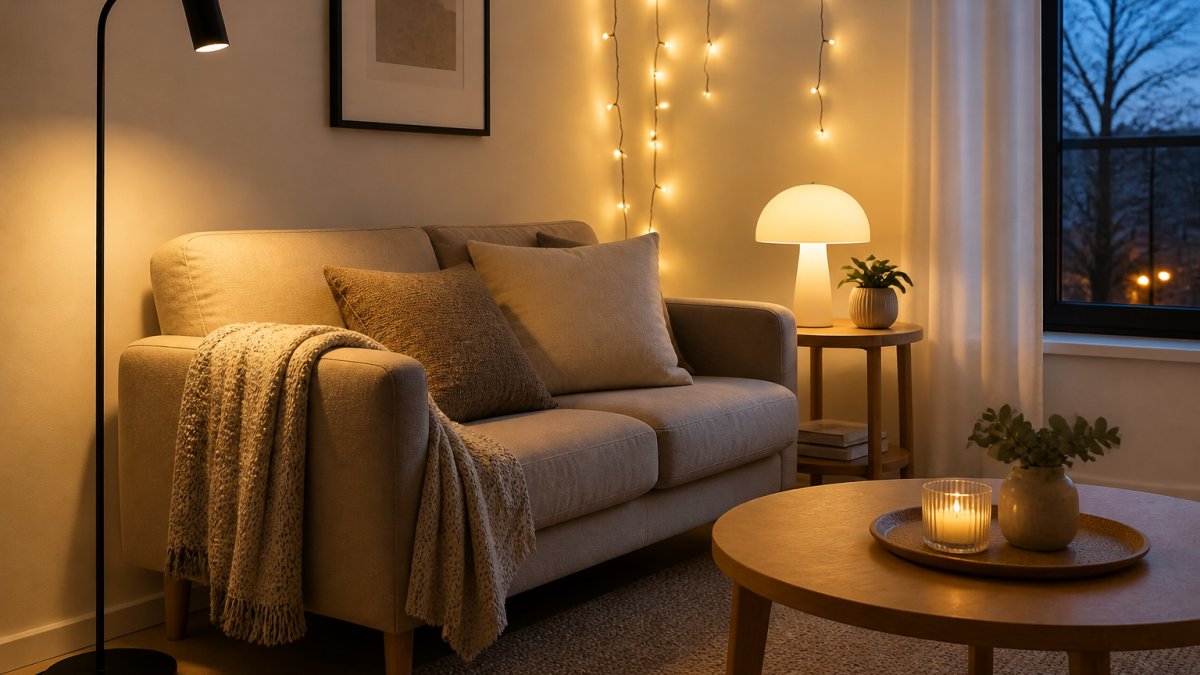
Floor Lamps, Table Lamps, and Arc Lamps
Floor lamps give you height without taking wall space; a slim column lamp beside the sofa adds light exactly where you read. Table lamps cost no floor at all.
One practical pick: our Mushroom Table Lamp ($99.00) has a low, rounded shade that throws soft light downward. It fits on a narrow side table and works well as an accent layer in a small seating area.

Wall Sconces and Plug-In Fixtures
Wall sconces use vertical space, which small rooms have in abundance. Mount them at eye level beside the sofa or above a reading chair.
For a softer layer, our Indoor and Outdoor Decorative String Lights ($10.00) run along a wall or drape across a corner. They add a warm glow without eating floor space.
Layered Lighting for Living Rooms: Ambient, Task, and Accent
Layered lighting for living rooms combines three jobs: ambient light for overall brightness, task light for reading and working, and accent light for mood and highlight.
Ambient light is your base, a ceiling fixture, an arc lamp, or several lamps bouncing light off walls.
The trick in a small room is to let one fixture do two jobs.
Living Room Lighting Without Overhead Lights
You can light a living room without overhead lights, and many small rooms look better that way. Skipping the ceiling fixture removes harsh downlight, keeps ceilings feeling higher, and lets you place light exactly where needed.
The result is even, flattering light with no single hot spot. It also solves a common rental problem: no ceiling wiring, no electrician, no damage.
Best Light Bulbs for Living Rooms: Lumens, Kelvin, and Dimmers
The best light bulbs for living rooms balance three settings: brightness in lumens, color temperature in kelvin, and dimmability. Get these right and the room feels calm.
Here is how to read a bulb label:
- Lumens: the actual brightness. Ignore watts for brightness; watts measure power use.
- Kelvin: the color of the light. 2700K is warm and cozy, 3000K is neutral, 4000K and up reads cool and clinical.
- Dimmable: check the box. A dimmer on a non-dimmable LED will flicker or buzz.
For a living room, aim for 2700K to 3000K bulbs. Warm light flatters skin tones and makes small spaces feel inviting. Cool light belongs in kitchens and workspaces, not beside the sofa.
Fix Glare, Shadows, and Screen Reflections
Glare, hard shadows, and screen reflections come from light placed at the wrong height or aimed at the wrong surface. Fixing them usually means moving a lamp a few feet, not buying anything new.
Try these fixes first:
- Glare in your eyes: raise or lower the shade so the bulb sits below eye level.
- Screen reflections: move the lamp out of the line between the screen and your seat, or angle the shade away from the TV.
- Hard shadows: add a second light source on the opposite side of the room.
A dimmer helps here too. Lower output at night cuts glare without turning the room dark.
Rental-Friendly and No-Wiring Lighting Solutions
Renters can light a small living room fully without touching the wiring. Plug-in fixtures, rechargeable lamps, and adhesive strips cover almost every need and move with you. The part most guides leave out is the practical detail: cord routing, outlet load, and what actually sticks to a wall without damage.
Plug-In Wall Sconces
Plug-in sconces mount with screws or adhesive and plug into a standard outlet. Plan two things first:
- Cord route: measure from the sconce to the nearest outlet. Most plug-in sconces come with a cord in the 6- to 8-foot range; if yours is shorter, you need an extension cord rated for the lamp's wattage and a cord cover to hide it.
- Mounting method: adhesive strips work on smooth, painted drywall but fail on textured walls, wallpaper, and brick. Screw-in mounting is more secure but leaves small holes you will need to patch at move-out.
Rechargeable Table Lamps
Rechargeable lamps need no cord, so they work on shelves and side tables far from an outlet. The trade-off is runtime: most run a few hours to a full evening per charge. Keep the charging cable in a drawer and top up during the day so the lamp is ready at night.
LED Strip Lights
LED strips stick under shelves or behind the TV for soft accent light. Buy strips with a dimmer and a warm-white option (2700K to 3000K) rather than fixed cool white. Adhesive backing on cheap strips fails in warm rooms; mounting clips hold better and let you remove the strip without peeling paint.
String Lights
String lights drape across walls and corners for instant warmth. Use clips or small hooks rather than nails, and keep the run short enough that the plug reaches an outlet without a long extension cord across the floor.
Floor Lamps
Floor lamps plug in and go, no installation required. Choose a slim base so the lamp does not eat floor space, and keep the cord against the wall rather than across a walkway.
Outlet and Load Basics
A standard living room circuit is typically shared with other outlets and fixtures, so do not pile every lamp onto one outlet through a daisy chain of power strips. Spread fixtures across outlets, use power strips with their own breaker for clusters, and keep extension cords out of walkways. If a breaker trips, move a lamp to another circuit.
Cord Management That Looks Intentional
A few dollars of cord management makes a rental look intentional rather than improvised:
- Cord covers run along baseboards and up walls and can be painted to match.
- Adhesive clips hold cords against furniture legs and wall corners.
- Cable sleeves bundle multiple cords from a lamp cluster into one line.
Controls for Rentals
You do not need an electrician for better control. Plug-in dimmers sit between the lamp and the outlet and lower output at night. Smart plugs schedule lamps and turn them off from your phone, which helps if outlets are behind furniture. Remote-control outlets suit lamps that are hard to reach.
Frequently Asked Questions
How much light do you need in a small living room?
A common starting point is roughly 10 to 20 lumens per square foot of floor space for general ambient light. A 120-square-foot living room lands around 1,200 to 2,400 lumens total, spread across several fixtures rather than one bright source. Layer a floor lamp, a table lamp, and accent lighting so you can dim or switch off parts of the room. Small rooms need less total output than large ones, so check the lumen rating on each bulb before buying.
How do you layer lighting in a small living room?
Layered lighting for living rooms means combining three roles: ambient light for overall brightness, task light for reading or working, and accent light for highlighting art or adding mood. In a small room, use one floor lamp or arc lamp for ambient glow, a table lamp near your seating area for tasks, and string lights or a sconce for accent. Put them on separate switches or smart plugs so you can control each layer independently.
What color temperature is best for living room lighting?
Warm white bulbs in the 2,700K to 3,000K range suit most living rooms because they feel relaxing and flatter skin tones and fabrics. Cooler bulbs around 4,000K work better for task lighting over a desk or reading chair. Avoid mixing wildly different color temperatures in one sightline, since the contrast looks uneven in a small space. Look for bulbs labeled dimmable if you plan to use a dimmer.
Are wall sconces or floor lamps better for a small living room?
Both work, and the right pick depends on floor space and wiring. Floor lamps need no installation and can be moved easily, making them ideal for renters. Wall sconces free up floor space and add vertical interest, but hardwired versions require an electrician; plug-in sconces avoid that. In tight rooms, a plug-in sconce above a sofa or a slim corner floor lamp often solves the layout problem best.
Lighting a small living room is a planning problem, not a shopping problem. Measure the room, set a lumens target, and build three layers at different heights. PracticalHomeEssentials.com can help you finish the job with a curated selection of lamps, string lights, and decor, plus home delivery and free shipping available. Browse our lighting and decor options to build a warmer, brighter small living room this week.