

How to Choose the Best Coffee Grinders for Home Brewing
Editorial TeamLast Updated: November 1, 2026
Quick Summary
The best coffee grinders for home brewing are burr grinders, because they crush beans to a uniform particle size instead of chopping them randomly like blade grinders. Our picks are all single-dose designs: the Geimori GU64 Gen2 with 64mm flat burrs, the GU38 at $179.99, and the portable T38 Plus at $139.99.
- A burr grinder is the entry ticket for anyone serious about home brewing.
- Flat burrs deliver a tighter, more uniform grind, which is why espresso brewers favor them.
- Single-dose grinders reward anyone who switches beans or brew methods.
- Measured noise levels for home grinders typically fall between 70 and 90 dB at the counter.
- Brush out the burr chamber weekly with a dry brush to keep grind settings repeatable.
Table of Contents
- What Home Brewing Enthusiasts Actually Need From a Coffee Grinder
- Burr Grinder vs. Blade Grinder: Why Particle Size Decides Brew Quality
- The Best Burr Coffee Grinder Picks for Different Brewing Routines
- Picking a Coffee Grinder for Espresso and Pour-Over Without Buying Twice
- Retention, Static, and Noise: The Workflow Details That Decide Daily Use
- Single-Dose vs. Hopper Workflow and What Each Costs Over Time
- How to Clean a Coffee Grinder So Grind Settings Stay Repeatable
- Matching a Grinder to Your Counter, Routine, and Budget
- Frequently Asked Questions
What Home Brewing Enthusiasts Actually Need From a Coffee Grinder
Coffee grinders are the single most overlooked piece of gear in most home setups, and the best coffee grinders repay that attention. Ask anyone who has spent a year chasing better coffee and they will tell you the same thing: the grinder matters more than the brewer. Many home brewers upgrade their machine and still get flat, muddy cups, only to find the culprit was a tired blade grinder on the counter.
Here is the core idea that runs through this whole guide: a grinder is not an accessory, it is the control dial for everything that happens downstream. Grind size sets how fast water moves through the bed of coffee, and speed sets extraction. Get the grind right and even an inexpensive brewer makes clean, sweet coffee. Get it wrong and no amount of expensive beans will save you.
Burr Grinder vs. Blade Grinder: Why Particle Size Decides Brew Quality
A burr grinder crushes beans between two abrasive surfaces set a fixed distance apart, so every particle comes out roughly the same size. A blade grinder spins a metal blade and chops beans at random, producing a mix of dust and boulders in the same dose.
That difference is the whole argument. When you brew, fine particles extract fast and coarse particles extract slowly. In a blade ground dose, the dust over-extracts and turns bitter while the boulders under-extract and taste sour, all in the same cup. You cannot fix that with technique.
For anyone serious about home brewing, a burr grinder is the entry ticket. Within burrs, the two families behave differently:
- Conical burrs feed beans down a cone and tend to produce a slightly wider particle spread, which suits filter coffee and forgiving brewers.
- Flat burrs run two parallel discs and deliver a tighter, more uniform grind, which is why espresso brewers favor them.
Neither is "better." Flat burrs give you more clarity and repeatability; conical burrs are typically easier to live with.
The Best Burr Coffee Grinder Picks for Different Brewing Routines
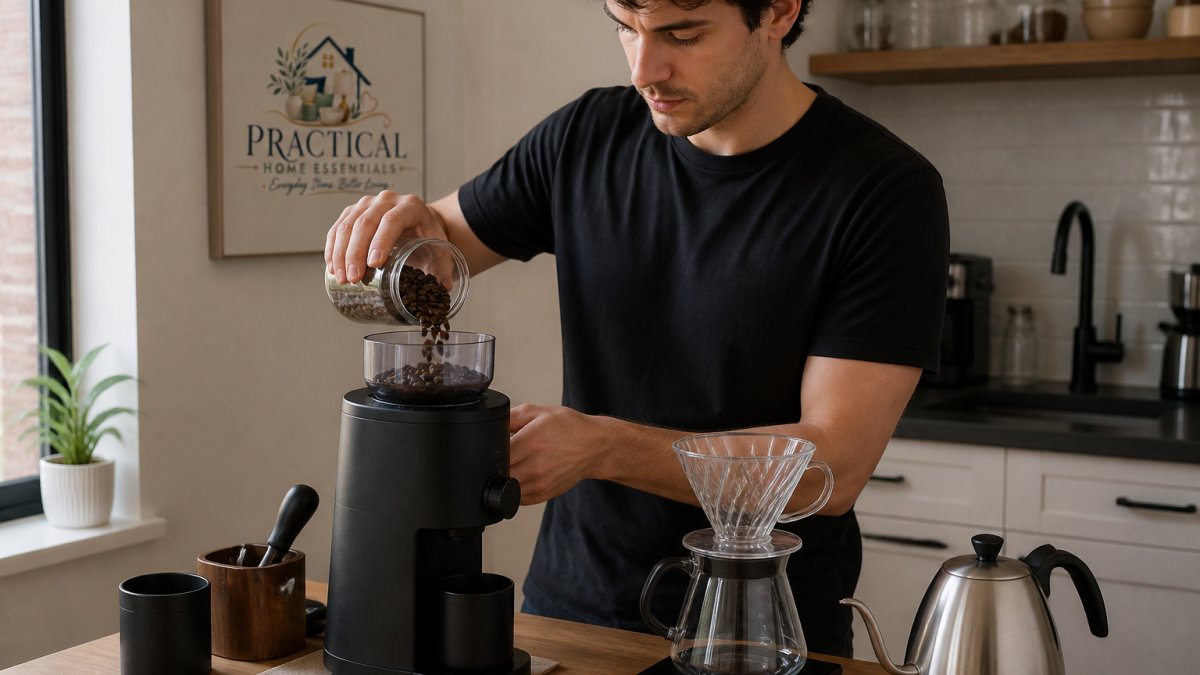
The right grinder depends on what you brew. A coffee grinder for espresso and pour-over duty is a different machine than one that only sees a French press. Our picks below cover the range, and all three are single-dose designs, which we will explain in a moment.
Geimori GU64 Gen2: 64mm Flat Burrs for Espresso and Filter Coffee
The GU64 Gen2 is a capable grinder for espresso drinkers. Its 64mm flat burrs give you the uniform particle size that dialing in a shot depends on, and the stepless adjustment lets you move in tiny increments instead of jumping between clicks. It offers adjustable RPM. It also features an anti-static design and zero retention.
Best for: Espresso and filter drinkers who want one grinder to do both well. Skip if: you are outfitting a first apartment on a tight budget.
You can see the full specs on the Geimori GU64 Gen2 64mm flat burr grinder page.

Geimori GU38: The Single-Dose Middle Ground
The GU38 is a single-dose grinder at $179.99.
Best for: Drip and pour-over brewers who want fresh grounds every morning without a hopper full of aging beans.
Geimori T38 Plus: A Portable Conical Burr Grinder for Small Kitchens
The T38 Plus uses 38mm conical burrs, stepless grind settings, and anti-static tech. Its product page has the full specs and purchase details. It is priced at $139.99.

Here is how the three picks compare on the facts that matter for daily brewing.
| Grinder | Price | Burrs | Best for |
|---|---|---|---|
| Geimori GU64 Gen2 | Not stated | 64mm flat, stepless, adjustable RPM | Espresso and filter drinkers wanting one grinder |
| Geimori GU38 | $179.99 | Not stated | Drip and pour-over brewers wanting fresh grounds daily |
| Geimori T38 Plus | $139.99 | 38mm conical, stepless, anti-static | Small kitchens needing a portable grinder |
Picking a Coffee Grinder for Espresso and Pour-Over Without Buying Twice
The most expensive mistake in home coffee is buying cheap, then buying again six months later. Two questions prevent it.
First, what is the finest grind you will ever need? Espresso demands a fine, tightly controlled grind, and a grinder that cannot go fine enough is useless for it no matter how good it is at coarse settings. If espresso is even a maybe, buy for espresso.
Second, do you want to weigh each dose or fill a hopper? Single-dose grinders reward anyone who switches beans or brew methods, because nothing is left sitting. Hopper grinders suit households that brew the same coffee every day and want speed.
Pair your grinder with the rest of your setup deliberately. A precision gooseneck kettle matters as much as the grind for pour-over, and the Bonavita 1.0L gooseneck precision temperature kettle is the kind of companion piece that makes temperature control one less variable.
Geimori GU64 Gen2 Coffee Grinder, 64mm Flat Burr →
Retention, Static, and Noise: The Workflow Details That Decide Daily Use
A grinder you dread using is a grinder you stop using. Three practical details separate a pleasant routine from a frustrating one, and they are the details most product pages omit.
Retention is the coffee left inside the machine after grinding. It hides in the chute, the burr chamber, and the exit path.
Static is why grounds cling to the catch cup and scatter across the counter. It comes from friction between particles and the grinder surfaces, and it gets worse in dry winter air. Common fixes include ionizers, grounded metal catch cups, and anti-static coatings.
Noise rarely appears in spec sheets but shapes real life. Burr grinders generally run quieter than blade grinders, though all electric grinders make noise. Flat-burr grinders with larger burrs often run at lower RPM and produce a lower-pitched hum; compact conical grinders can be louder per gram because they spin faster.
A grinder you dread using is a grinder you stop using. Three practical details separate a pleasant routine from a frustrating one.
Single-Dose vs. Hopper Workflow and What Each Costs Over Time
Single-dose means you weigh beans per brew and grind them all. Hopper means you fill a container and grind by time. The choice shapes freshness, convenience, and how repeatable your recipes are.
Single-dose workflow wins on freshness and switching between coffees. Because you weigh each dose, your recipes are repeatable: the same 18 grams in produces the same 18 grams out (minus retention), so dialing in a new bean takes fewer shots. The trade-off is an extra 20-30 seconds on the scale each morning and the need to store beans separately.
Hopper workflow is faster for a household that drinks the same coffee daily. Fill the hopper, set the timer, grind. But beans in a hopper age faster than beans in a sealed bag, and switching coffees means emptying the hopper or blending old and new. Hopper grinders often have higher retention, so the first dose of the day may include grounds from yesterday.
The cost side: total cost of ownership
Upfront price is only part of the story. A well-built burr grinder is a one-time purchase that outlasts several cheap replacements, but the long-term cost depends on burr replacement, warranty, and repairability.
Pair your grinder with the rest of your setup deliberately. A precision gooseneck kettle matters as much as the grind for pour-over, and the Bonavita 1.0L gooseneck precision temperature kettle is the kind of companion piece that makes temperature control one less variable.
How to Clean a Coffee Grinder So Grind Settings Stay Repeatable
Cleaning is maintenance, and maintenance is what keeps a grinder accurate. Old oils and packed fines change how beans feed through the burrs, so your carefully dialed setting starts producing a different grind.
A simple routine keeps things honest:
- Brush out the burr chamber weekly with a dry brush
- Grind a small handful of raw rice or a dedicated grinder cleaning tablet monthly to lift oils
- Wipe the catch cup and chute, never wash electric grinder parts in water
- Re-zero your settings after reassembly and pull one test brew
Matching a Grinder to Your Counter, Routine, and Budget
Measure the spot before you buy, since grinder sizes vary.
Match the grinder to your routine, not to a fantasy version of it. If you brew one pour-over before work, a compact single-dose grinder is plenty. If you are pulling espresso on weekends and filter on weekdays, buy the flat-burr machine once and skip the upgrade cycle.
Budget-wise, our three picks span $139.99 to $399.99, and each one is a one-time purchase rather than a subscription. For more ways to save, see these budget kitchen gadgets and affordable alternatives.
Frequently Asked Questions
What is the best coffee grinder for home brewing?
Start with burr grinders, not blade grinders. For most home setups, a single-dose burr grinder gives the most control over dose and grind size. The Geimori GU64 Gen2 at $399.99 uses 64mm flat burrs, stepless adjustment, and adjustable RPM, which suits espresso and filter brewing. The GU38 at $179.99 is the lower-cost single-dose option, and the T38 Plus at $139.99 is a portable 38mm conical burr grinder for small kitchens.
Are burr grinders better than blade grinders for coffee?
Yes, for brewing. A blade grinder chops beans into mixed particle sizes, so fine dust and coarse chunks extract at different rates and the cup tastes uneven. Burr grinders crush beans between two surfaces and produce a more uniform particle size, which makes extraction predictable. That uniformity matters most for espresso, where small grind changes shift the shot, and for pour-over, where consistent bed depth keeps the brew even.
Do I need a different coffee grinder for espresso and pour-over?
Not necessarily, but the grinder needs a wide enough grind range and fine adjustment. Espresso requires fine, repeatable settings, while pour-over and drip need coarser grinds. The GU64 Gen2 and GU38 both use stepless adjustment, so you can dial in small changes between brew methods. If you switch methods daily, note your settings so you can return to them without re-dialing from scratch.
How often should I clean my coffee grinder?
Brush out the burr chamber weekly if you grind daily, and do a fuller clean monthly. Old grounds and oils build up on the burrs, which affects grind consistency and can make fresh coffee taste stale. Empty the chamber, brush the burrs and chute, and wipe surfaces that contact grounds.
The real challenge is not picking a grinder. It is building a coffee corner that works every morning without fuss, and that means gear chosen for your actual routine. PracticalHomeEssentials.com curates kitchen and home goods with that in mind: a wide product selection across brewing gear, free shipping available, and exceptional customer support if a piece does not fit your space. Get started with PracticalHomeEssentials.com and build a counter setup you will actually use before the first cup.
