

Choosing a Dutch Oven for Beginners: Size, Shape, Material
Editorial TeamLast Updated: October 30, 2026
Quick Summary
For most beginners cooking for two to four people, a 5-quart round Dutch oven is the right starting size, handling a whole chicken, a batch of chili, and a small loaf of bread. Choose enameled cast iron for easier cleanup and acidic foods, and never fill a dutch oven more than about two-thirds full.
- A quart of pot capacity yields roughly one generous main-course serving at the two-thirds fill line.
- Round pots heat more evenly and fit standard burners better than oval pots for beginners.
- Enameled cast iron lets you cook acidic foods like tomato sauce without reacting with raw iron.
- Check the lid knob's oven rating, since plastic knobs are often limited to 350°F to 400°F.
- Wash enameled cast iron with warm water, mild soap, and a soft sponge, and skip the dishwasher.
Table of Contents
- Why a Dutch Oven Belongs in a Beginner Kitchen
- What Size Dutch Oven Should I Buy?
- Round vs. Oval Dutch Oven: Which Shape Fits Your Kitchen?
- Enameled vs. Cast Iron Dutch Oven: What Beginners Should Know
- What to Cook in a Dutch Oven: Beginner-Friendly Uses
- Stovetop, Oven, and Outdoor-Fire Compatibility
- Beginner Care, Common Mistakes, and What to Ignore
- Choosing Your First Dutch Oven at PracticalHomeEssentials.com
- Frequently Asked Questions
Why a Dutch Oven Belongs in a Beginner Kitchen
A Dutch oven is a heavy, lidded pot, usually made of cast iron, that moves from stovetop to oven and holds heat long enough to turn cheap cuts of meat into tender braises. For a beginner cook, it replaces three or four lesser pans at once.
That is the pitch, anyway. Here is the honest version: most beginners buy the wrong size, pick a shape that fights their stove, and then let the thing sit in a cabinet because it weighs more than their laptop.
What Size Dutch Oven Should I Buy?
For most beginners cooking for two to four people, a 5-quart Dutch oven is the right starting size. It handles a whole chicken, a batch of chili with leftovers, and a small loaf of bread without crowding.
Size is where first-time buyers overthink and under-research at the same time. A pot that's too small forces you to cook in batches. A pot that's too large takes forever to heat and is miserable to lift when full. The fix is to stop shopping by quart number and start shopping by the meals you actually cook.
Translate Quarts Into Real Meals
A quart is a volume measure, not a serving count, so use these working equivalents to compare pots. They assume a normal two-thirds fill level and a hearty main-course portion:
- 3 quarts: about 2.5 quarts of usable space. Fits a whole chicken up to roughly 4 pounds, a double batch of bean soup, or a 2-pound pot roast. Yields 3 to 4 dinner portions, or dinner for two plus two lunches.
- 5 quarts: about 3.3 quarts usable. Fits a 5-pound chicken, a 4-pound chuck roast, a batch of chili from 2 pounds of ground beef, or a standard no-knead bread loaf in a 4- to 5-quart range. Yields 4 to 6 portions, or dinner for four plus a container of leftovers.
- 6 quarts: about 4 quarts usable. Fits a 6- to 7-pound chicken or two smaller ones, a 5-pound pork shoulder, or a full batch of stew for a family plus freezer portions. Yields 6 to 8 portions.
- 7 quarts and up: about 4.5 to 5 quarts usable. Built for batch cooking, stock, large roasts, and big bread loaves. Yields 8 or more portions, and the full pot gets heavy fast.
A useful rule of thumb: one quart of pot capacity yields roughly one generous main-course serving when the pot is filled to the two-thirds line. That is why a 5-quart pot lands comfortably at four to six servings rather than the eight or ten a beginner might expect from the label.
Capacity and Practical Fill Level
Never fill a Dutch oven more than about two-thirds full. That headroom is not decorative; it is what stops a simmering stew from boiling over onto your oven floor, and it leaves room for the bubbling and steam that a tight lid traps.
Two more capacity checks beginners skip:
- Browning space matters as much as volume. Meat browns, it steams. If you plan to sear a 4-pound roast, the meat needs to sit in a single layer with a little room around it. A 5-quart pot handles a 3- to 4-pound roast; a 3-quart pot will force you to brown in batches.
- Bread needs a specific range. Most no-knead and sourdough recipes are written for a 4- to 6-quart pot. A pot that is too wide spreads the loaf flat; one that is too narrow crowds it against the walls.
Serving Sizes by Household
Use this as a rough map, then adjust for how much you like leftovers:
| Household | Recommended Size | Realistic Yield |
|---|---|---|
| Cooking for one | 3-quart round | 2-3 meals with leftovers |
| Couple | 4-5 quart round | Dinner plus 2 lunches |
| Family of four | 5-6 quart round | One dinner, small leftovers |
| Batch cooking or bread baking | 6-7 quart round | Freezer portions or a large loaf |
Round vs. Oval Dutch Oven: Which Shape Fits Your Kitchen?
Round is the better default for beginners. It heats more evenly, fits standard burners, and takes up less cabinet space.
The trade-off is real, though.
Measure your oven and your tallest cabinet shelf before you commit. You can see the shape and dimensions on this oval Dutch oven listing.
Best for: whole chickens, roasts, and anyone with a wide oven. Skip if: you cook mostly stews, soups, and chili, or your storage is tight.
Enameled vs. Cast Iron Dutch Oven: What Beginners Should Know
Enameled cast iron is the easier first purchase.
Bare cast iron needs seasoning, reacts with acidic ingredients, and rewards patience.
Enameled cast iron is cast iron with a fused glass coating. It gives you the heat retention of iron with a non-reactive, easy-clean surface.
One warning worth taking seriously: Watch out: never heat an empty enameled pot on high or plunge a hot one into cold water.
For a concrete look at the style, see the 6-quart red enamel cast-iron Dutch oven.
6 Quart Red Enamel Cast-Iron Dutch Oven →

Weight, Lifting, and Storage
A full 6-quart Dutch oven can weigh well over 15 pounds, and that's before you add a pot roast. Lift it with both hands, and use oven mitts every time.
Store the lid off or with a folded towel between lid and pot to protect the enamel rim. If you have shoulder or wrist issues, size down. A lighter pot you actually use beats a bigger one you avoid.
What to Cook in a Dutch Oven: Beginner-Friendly Uses
Soups, stews, chili, braises, and no-knead bread are the five easiest wins. All of them are forgiving, and all of them benefit from the pot's even heat and tight-fitting lid.
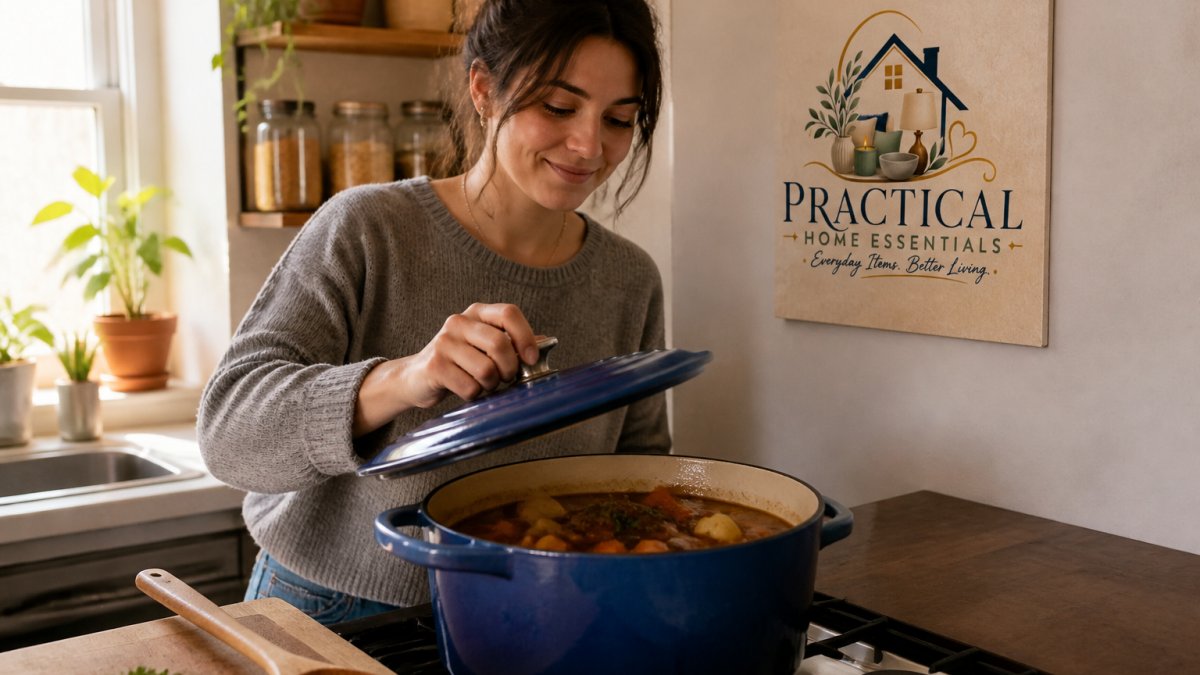
Start with chili or a simple beef stew. Both tolerate small mistakes, and both teach you how the pot behaves.
Bread baking is where the Dutch oven surprises people. The sealed lid traps steam, which gives sourdough and no-knead loaves a crackly crust that's hard to get any other way. Roasting a whole chicken is the other crowd-pleaser.
Stovetop, Oven, and Outdoor-Fire Compatibility
Most Dutch ovens work on gas, electric, and induction stovetops and are oven-safe, but "most" is not a guarantee. Before you buy, run these checks in order. Each one takes a minute and prevents the two most common beginner failures: a pot that spins or scorches on the wrong burner, and a lid knob that melts under the broiler.
Check 1: Stovetop Compatibility
- Gas: nearly any Dutch oven works. The flame contacts the pot bottom directly, so heat is even and predictable.
- Electric coil and glass-top: works, but match the pot base to the burner size. A base much wider than the burner leaves the outer ring cold; a base much narrower concentrates heat in the center and can scorch. Glass-top ranges also scratch, so lift the pot rather than sliding it.
- Induction: the pot must be magnetic. Enameled cast iron almost always is, because the core is iron. Test with a magnet on the base before buying, or look for an "induction compatible" claim on the packaging. Bare cast iron passes; some thin enameled steel pots do not.
A round pot centered on a round burner is the safest configuration. This is the practical reason round beats oval for beginners: an oval pot on a round burner leaves cold spots at each end, so you rotate it more often.
Check 2: Oven Temperature Limits
The pot body and the lid knob often have different limits. Enameled cast iron bodies commonly carry oven ratings in the 450°F to 500°F range, but the knob is the weak point. Plastic and some composite knobs are frequently rated only to 350°F to 400°F, and a broiler can push the top of the pot past that in minutes.
- Look up the manufacturer's stated maximum oven temperature for the specific model, not the category.
- Check the knob material. Stainless steel knobs usually match the pot's limit; plastic knobs often do not.
- If you plan to broil or bake bread at high heat, confirm the knob is rated for it, or plan to replace the knob with a metal one.
- Never use the broiler with the lid on unless the manufacturer explicitly allows it.
Check 3: Handles and Lid Clearance
Confirm the handles are oven-safe and positioned so you can grip them with mitts. Some decorative handles are too small or too close to the body to grab safely when the pot is hot and full. Measure your oven interior and your tallest cabinet shelf before buying a large pot; a heavy lid needs clearance above it, and a 7-quart pot is wider than most people expect.
Check 4: Outdoor and Open-Fire Use
Outdoor use splits by material:
- Bare cast iron with legs is built for direct coals. The legs lift the pot above the heat and the bare surface tolerates ash and embers.
- Enameled pots can go over a fire, but coals on the enamel will stain or chip it. Keep the heat under the pot and off the coating, and avoid direct contact between coals and the enameled sides.
- Indoor enameled pots without legs are not designed to sit in a fire pit. The coating and the knob are the failure points.
Beginner Care, Common Mistakes, and What to Ignore
Wash enameled cast iron with warm water, mild soap, and a soft sponge. Skip the steel wool, skip the dishwasher, and dry it fully before storing.
The mistakes we see most often:
- Heating an empty pot on high heat
- Using metal utensils that chip the enamel
- Stacking other pans inside without protection
- Skipping oven mitts on a hot, heavy lid
Ignore the advice to "never use soap" on enameled pots. That rule belongs to bare cast iron. Enamel is glass; soap does nothing to it.
Choosing Your First Dutch Oven at PracticalHomeEssentials.com
The short version: a 6-quart enameled cast iron Dutch oven is a practical starting point for many home cooks.
At PracticalHomeEssentials.com, you can find enameled cast iron Dutch ovens in several colors, including red, baby blue, pink beige off-white and light grey. Home delivery is available, and free shipping is available on eligible orders.
Frequently Asked Questions
What is a good size Dutch oven for a beginner?
Smaller 3- to 4-quart pots suit one or two cooks, while 7 quarts and up only make sense if you regularly feed a crowd or want serious leftovers. If you buy one pot, size it to your usual household plus a little headroom.
Is a round or oval Dutch oven better for beginners?
If your stove has limited space or you cook mostly one-pot meals, start round and add oval later.
Should a beginner buy enameled or bare cast iron?
Enameled cast iron is one option for a first Dutch oven; the product listings describe enameled cast-iron construction. For most home cooks cooking soups, stews, and bread, enameled cast iron offers more day-to-day convenience.
How do you care for an enameled Dutch oven?
Let the pot cool before washing, then use warm water, mild dish soap, and a soft sponge. Skip metal utensils and abrasive scrubbers, which can chip the enamel. Dry it fully before storing, and avoid sudden temperature swings like plunging a hot pot into cold water. Most enameled Dutch ovens are dishwasher safe, but hand washing keeps the finish looking new longer.
